Where uptime monitoring endsAnd synthetic telemetry begins
Better Stack Uptime bundles uptime, incident, and status into one product. Yorker goes deep on OTel-native synthetic checks that land in your own backend: full Playwright filmstrips, private locations, and W3C trace propagation, included in one plan.
Last verified 2026-06-13
# Yorker platform, $29.99/mo
browser_checks    included in plan
filmstrip         every run
private_locations included
otel_export       included

# Better Stack Uptime
uptime_monitors   10 free; $25/50 more
browser_checks    $1 per 100 min
private_locations not supported
otel_export       not supported
Different products for different problems
Better Stack's UI is built around incidents as the primary object. Yorker's is built around telemetry and check results that flow into your own observability backend, where you already query everything else.
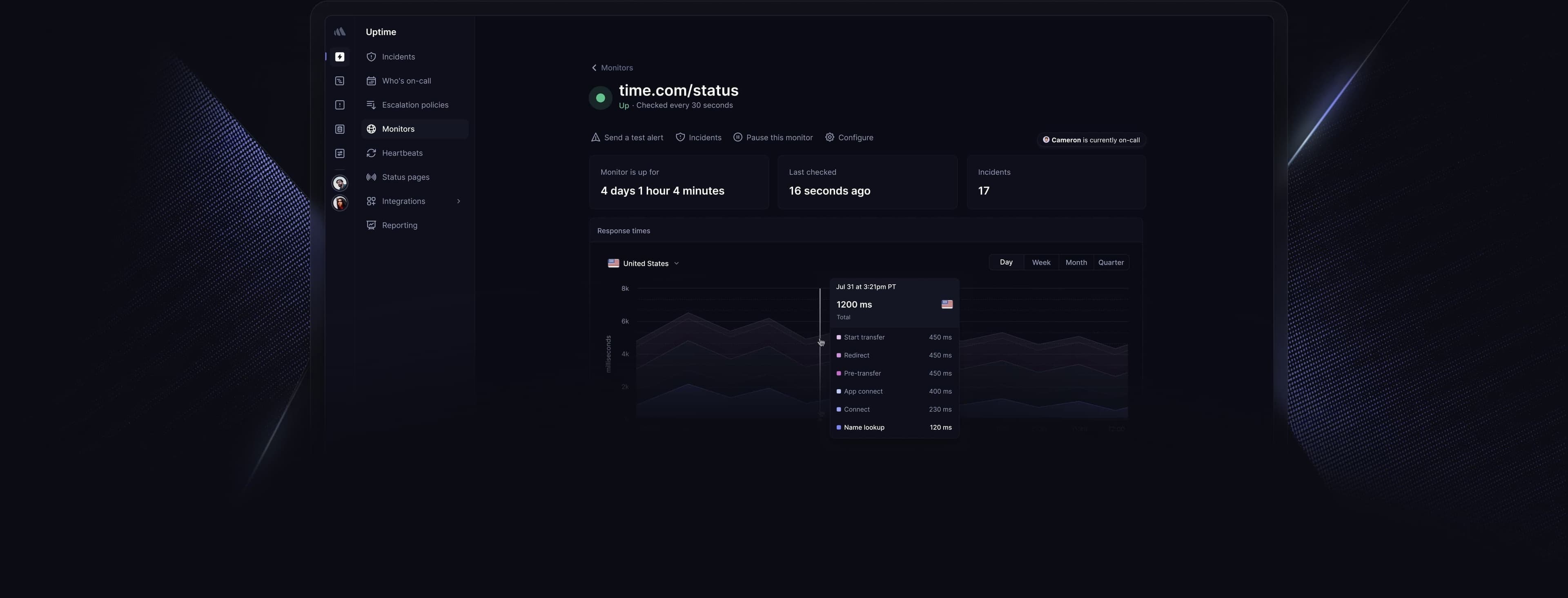
Screenshot: Better Stack, via betterstack.com/uptime, accessed June 13, 2026.
Why teams switch their synthetic monitoring to Yorker
Yorker emits OTLP metrics, traces, and logs from every check run to your existing observability backend. Better Stack ingests telemetry but Uptime checks do not emit OTLP, so synthetic results stay inside Better Stack's platform.
Yorker captures a per-step screenshot sequence for every browser check run, pass or fail. Better Stack captures screenshots when an error occurs. Debugging intermittent visual regressions requires the full sequence, not just the failure frame.
Yorker private location agents run outbound-only from your network: no inbound firewall rules, included in the platform plan. Better Stack Uptime does not offer private location agents for behind-firewall monitoring.
Yorker injects a W3C traceparent header into every browser-check HTTP request. Synthetic runs appear as spans in your distributed traces, queryable in the same backend as your application traces, without any per-monitor configuration.
Yorker's platform plan includes browser checks with a monthly run allowance. Better Stack bills Playwright checks at $1 per 100 minutes, purely consumption-based with no inclusion. Predictable billing matters when you're scaling check coverage.
Yorker check definitions are plain YAML: one config file, no Terraform state, no provider SDK. Readable by any engineer. Better Stack's MaC approach uses a Terraform provider, which adds a build dependency to your monitoring workflow.
Feature-by-feature, tier-by-tier
Better Stack Uptime is priced per monitor block rather than in named tiers: 10 monitors free, additional 50-monitor blocks at $25/month each. Browser checks are $1/100 Playwright minutes on top. This table shows both columns against Yorker's platform plan.
| Capability | Yorker Platform · $29.99/mo | Better Stack Uptime Free (10 monitors) | Better Stack Uptime + monitor blocks ($25/mo each) |
|---|---|---|---|
HTTP / uptime checks Ping a URL, verify status and response. | Included | Included (10 monitors) | Included (50/block) |
Browser / Playwright checks Full headless browser with filmstrip. | Included in plan | $1 per 100 Playwright minutes | $1 per 100 Playwright minutes |
Check interval How frequently checks run. | 30s – 60m | 30-second minimum | 30-second minimum |
Screenshot filmstrip Per-step visual evidence on every run. | Included | Error screenshots only | Error screenshots only |
Private locations Run checks from behind your firewall. | Included | Not supported | Not supported |
OpenTelemetry export OTLP metrics to any backend. | Included, OTel-native | Not supported | Not supported |
W3C trace propagation traceparent injected into check requests. | Always on | Not supported | Not supported |
Monitoring as Code Check definitions in source control. | YAML (CLI) | Terraform provider | Terraform provider |
Hosted locations Global regions available out of the box. | 14 regions | Multi-location | Multi-location |
Pricing verified June 13, 2026 from betterstack.com/pricing. Better Stack: 10 uptime monitors free; additional 50-monitor blocks $25/mo (monthly) or $21/mo (annual, ~16% off); Playwright browser tests $1/100 minutes. Responder (incident management) licenses are separate: $29/mo per responder (annual). Yorker platform plan $29.99/mo with full pricing at /pricing. Spot something changed? Email [email protected].
Frequently asked
Is Yorker more expensive than Better Stack?
For uptime-only monitoring of a small fleet, Better Stack's free tier (10 monitors) costs nothing. Yorker starts at $29.99/month. However, for teams that need browser checks, private locations, or OTel telemetry, Better Stack's per-minute Playwright pricing ($1/100 min) and lack of private location support mean costs diverge quickly as usage grows.
Does Better Stack do OTel export like Yorker?
Better Stack has an observability product (logs, metrics, traces ingestion) but its Uptime monitoring does not emit OTLP telemetry from synthetic checks to external backends. Yorker's synthetic results land in your chosen backend as standard OTLP: ClickStack, Grafana, Honeycomb, or any OTLP-compatible destination.
How do Playwright browser tests compare between the two?
Both products support Playwright-based browser tests. Better Stack prices browser runs at $1 per 100 Playwright minutes, a pure consumption model with no inclusion in the base price. Yorker includes browser checks in the platform plan with consumption pricing for volume above the monthly allowance, and every run produces a full filmstrip, not just error screenshots.
Does Yorker do incident management like Better Stack?
Yorker is the synthetic-monitoring and OTel layer, not an on-call scheduler. It emits standard OTLP and fires alerts that your existing incident and on-call tooling consumes: PagerDuty, Opsgenie, Slack. That keeps escalation policies, schedules, and runbooks in the systems your team already operates, instead of locking them inside the monitoring vendor.
What about private locations: can Better Stack run checks behind a firewall?
Better Stack Uptime does not offer private location agents for running checks inside a private network, based on their current public documentation. Yorker includes private location agents in the platform plan: outbound-only, no inbound firewall rules required.
Is migration from Better Stack difficult?
The declarative config (URL, interval, alert contact) translates cleanly to Yorker YAML. Playwright scripts need the async function wrapper swapped for Yorker's format, typically a 5-minute change per script. Incident routing needs a manual re-setup in your incident management tool.
Related Reading
Ready to go deeper than uptime pings?
Start free, no credit card, and run your first OTel-native synthetic check in minutes. Private locations, browser filmstrips, and W3C trace propagation all in one plan.